

Canada in World War I and in World War II
Two Wars. One Tour.

For Canadians
Walk In Their Footsteps

Wherever exceptional bravery and fortitude were required, there was a Canadian getting the job done.
This is not a broad 'Allied Effort' tour where not enough time is given to Canada's many significant and essential contributions.
This tour is the deep dive. We explore, experience, remember, and celebrate Canadian paths during both wars.
We also bear witness to the lengths that Europeans take - to this day - to express gratitude to their Canadian liberators.
World War I
In Brief
Vimy Ridge, Passchandele, the Somme, Arras, Cambrai, Denain, Valenciennes, Neuve Chapelle, Ypres, Verdun, Courcelette, Canal du Nord, Mons...
51,000 Canadians gave their lives in World War I, fighting from the first poison gas attack at Ypres in 1915 to the taking of Mons in 1918 - on the last day of the war.
We'll see where it all happened and get a real sense of the scope and scale of the tremendous Canadian effort.

World War II
In Brief
Dunkirk, Dieppe, Juno Beach, Bény-sur-Mer, Caen, Verriers Ridge, Falaise, the Atlantic Wall, Bruges, Adegem, the Scheldt, Groesbeek, Rha, Apledoorn, Westerbork, Groningen, Oldenburg.
Canadians went just about everywhere on the planet in World War II. We'll focus on the period from D-Day through to the end of the war in Europe.
42,000 Canadians gave the ultimate sacrifice for the freedom of others in WWII. 10% of the entire population of Canada served. That's incredible.
We'll also talk about other Canadian deployments like Hong Kong, Italy, Southern France, the Blitz, the Battle of Britain, Iceland, Alaska, the home front, the Royal Canadian Navy, and the Canadian Merchant Navy.
NEXT TOUR:
September 21 to October 3, 2027 12 Rooms Available.
September 22 to October 4, 2026 SOLD OUT
COST: This 12-night tour is $9,250 U.S. per person based on double occupancy.
The deposit to reserve your seat is $499 per person based on double occupancy.
A QUICK ITINERARY
(Scroll down for more detail.)
DAY 1 - PARIS/VERSAILLES Arrival In Europe
DAY 2 - VERSAILLES TO JUNO BEACH
DAY 3 - THE BATTLE FOR CAEN
DAY 4 - LE HARVE, HONFLEUR & DIEPPE
DAY 5 - THE SOMME & ARRAS
DAY 6 - VIMY, FLANDERS & YPRES
DAY 7 - THE V2, THE ATLANTIC WALL, DUNKIRK
DAY 8 - BRUGES & ADAGEM
DAY 9 - BATTLE OF THE SCHELDT
DAY 10 - DELFT
DAY 11 - GROESBEEK, APELDOORN, WESTERBORK
DAY 12 - GRONINGEN, KAZEMATTEN, AMSTERDAM
DAY 13 - TOUR END IN AMSTERDAM

DETAILED ITINERARY
DAY 1 PARIS/VERSAILLES
ESSENTIALS
-
Land at Paris' Charles de Gaulle (CDG) Airport
-
Taxi to Versailles
-
WWI Treaty of Versailles Tour (optional)
-
Welcome Dinner

(Actual hotel photo.)
DETAILS
Land at Paris' Charles de Gaulle (CDG) Airport and travel to Versailles in time for the evening welcome dinner. We depart for Normandy tomorrow after breakfast. Travel time from the airport to Versailles is about one hour and fifteen minutes.
Whether you've arrived in France today, or you've been in Europe for a few days, today is the day to catch a cab to Versailles. When you arrive, we think you'll be absolutely thrilled to be welcomed at your five star hotel near the palace. Our hotel served not only as Eisenhower's HQ in 1945, but was also visited by Hitler's Architect Albert Speer both before the war, and as a prisoner afterwards.
If you've still got the energy, we'll be leading an optional afternoon tour of the Hall of Mirrors at the adjacent Palace of Versailles to see where the infamous Treaty of Versailles was signed at the end of World War I.
If you'd prefer, you can tour the Palace of Versailles on your own or skip the lines to get in to the palace with a private guide. Just remember to pre-book your palace visit a week in advance according to your schedule. There is a lot to see! Wear comfortable shoes and, if you can, don't miss Marie Antoinette's apartments or her faux fairy-tale village.
Not up for a lot of walking today? Enjoying the hotel spa is another option. Or how about tea time at the hotel?
Shopping in Versailles is an unhurried and elegant experience compared to the high fashion buzz of Paris. Expect timeless French craftsmanship and authentic local charm. You'll find boutiques, elegant smaller French brands, charming markets and hidden gems tucked along cobbled streets.
Fine French gloves, a perfumery, exceptional cheeses and wines, antiques and art are all available.
We'll meet as a group for the Welcome Dinner in the hotel's Michelin-starred restaurant. Expect specialties like Langoustine ravioli in lemongrass bisque, line-caught sea bass with caviar or milk-fed veal with truffle jus.
(Actual hotel photo.)

DAY 2 VERSAILLES/JUNO BEACH
ESSENTIALS
-
Luxury Coach to Normandy
-
British Airborne Landings
-
Sword Beach
-
Juno Beach
-
Canada House
-
Overnight in Normandy

(Actual hotel photo.)
After your breakfast overlooking the Park of the Palace of Versailles, we’ll board our luxury coach for a panoramic window view of the French countryside as we ride to Normandy.
Pegasus Bridge is our first stop. We’re getting really close to Juno Beach now, and you’ll see why this bridge had to be taken at midnight and held by British paratroopers before the 3rd Canadian Division landed at dawn.
Sword Beach is just down the road from the bridge. We’ll stop and take a look at some of the important monuments to the British 3rd Infantry Division before driving along the coastal road to Juno Beach.
Lunch will be a gastronomic delight featuring fresh local seafood. Normandy is also famous for its butter, cream, camembert, lamb, cider, apple tart, and veal with crème fraîche and mushrooms.
Juno Beach is the highlight of our afternoon. You'll have time to walk the sands and see where it all happened. We'll get a private tour at the Juno Beach Centre and visit the German 'Resistance Nest' gun emplacement on the boardwalk of Saint Aubin-sur-Mer.
Canada House was the first to be liberated by Canadians when they used grenades to dislodge German forces hiding in the basement. The Queen's Own Rifles of Canada took the soldiers prisoner in the south yard.
Our accommodations tonight will be one of the grander five star beachfront hotels, or one of the elegant chateaus in the region. Wherever we stay, get ready for more immersion into Normandy's culinary bounty.
(Actual hotel photo.)

DAY 3 THE BATTLE FOR CAEN
ESSENTIALS
-
Putot-en-Bessin
-
Bény-sur-Mer Cemetery
-
Abbey d'Ardenne
-
Verriers Ridge
-
Mulberry Harbor

(Actual restaurant photo.)
Enjoy a gourmet breakfast at your château-hotel. Sip café crème with a selection of Normandy cheeses, figs, and fresh croissants still warm from the oven.
Our first coach stop will be to honor the Canadian soldiers who fought against the German 12th SS Panzer Division at the battle of Putot-en-Bessin.
Just outside the quaint village of Reviers, we'll visit the immaculate grounds of a Canadian cemetery where more than 2,000 soldiers rest. You'll have time to walk the rows of white headstones maintained with the utmost care by the Commonwealth War Graves Commission. Using their App you can follow a path and read stories along the route. Headstones even have a scan function so that you can learn more about the fallen.
We'll drive to a serene medieval abbey outside Caen to visit the moving garden memorial to 20 brave, and far too young, Canadian soldiers who were murdered over the course of several days in cold blood after capture by the 12th SS Hitlerjugend Division. This stop is emotionally intense, powerful, poignant, and unforgettable. You'll remember these young boys long after you return home.
For lunch we're going to gather energy for the rest of the day by seeking out a Michelin-starred inn for delicacies such as duck with Calvados glaze and apple tarte fine with crème fraîche. Perhaps some crisp Chablis is in order. Or if we can swing it, we'll have exclusive access to one of the region's famous farm-to-table restaurants that only accepts group bookings. They only use local farmed produce from Normandy.
As we head south, we'll reach a memorial at a place of hard-fought Canadian sacrifice - where the Black Watch and other regiments faced overwhelming resistance in July of 1944. British and Polish divisions were also involved, facing 3 SS divisions. Locals still find leftover welded mesh that had been laid down in order to land tanker planes on the temporary airfields that subsequently dotted the region.
Heading back up to the beach, we'll arrive at Arromanches where we'll get an amazing view of one of the most important reasons the Allies were successful in the summer of 1944.
(Actual restaurant photo.)

DAY 4 LE HARVE, HONFLEUR & DIEPPE
ESSENTIALS
-
Beautiful Honfleur
-
Operation Astonia, Le Havre
-
Dieppe Raid & Liberation

(Actual lunch restaurant photo.)
Clearing the channel coast at the end of the summer of 1944 was a huge task for the First Canadian Army after the initial Normandy Campaign. We'll start along that route today as we travel along the English Channel moving east, away from the D-Day beaches.
Flowing down from Paris, the Seine River reaches the sea at Honfleur - one of the most-painted, most-photographed towns in France. We'll have some free time here in the first half of the day for photos, pastries and shopping.
After crossing the Seine, we'll make a quick visit to Le Harve, the port city that was put under a combined land, air and sea siege.
Lunch will be the freshest available seafood with the best possible view over the channel.
We'll then continue to move up the coast to Dieppe. A town that needs no explanation to World War II enthusiasts.
In Dieppe we'll have time to walk the beaches, visit Canada Square and look up at the flanking cliffs as we reflect on two very different days. Both the fateful day of the raid in August 1942, and the celebrated 'spit-and-polish' parade through town of the entire 2nd Division on the first of September, 1944.
We'll also visit a local museum and travel south of town to the Canadian War Cemetery to cap off an important day of remembrance.
(Actual restaurant photo.)

DAY 5 THE SOMME & ARRAS
ESSENTIALS
-
V1 Launch Site
-
Battle of Amiens
-
Somme Museum
-
Lochnagar Crater
-
Memorial to the Missing
-
Ulster Tower
-
Thiepval Wood
-
Courcelette Canadian Memorial
-
Beaumont-Hamel Newfoundland Memorial

(Actual hotel photo.)
Before we pull away from the channel coast, we'll stop and visit a WWII V1 rocket launch site in the area. It was Canadians who put a stop to the Nazi terror campaign against England of both V1 and V2 rockets as Canada retook the 'Haute-Normandie', 'Picardie' and 'Nord-Pas-De-Calais' regions in the autumn of 1944.
Our next stop is the memorial to the 100,000 Canadians who drove the Germans 8 miles east in The Battle of Amiens in the summer of 1918.
We'll head northeast from there to the town of Albert and explore an underground museum dedicated to a soldier's life during WWI.
After an incredible lunch in Albert we'll visit the astounding Lochnagar Crater. Created by a large mine that was detonated beneath the German front line by British tunneling engineers. The explosion marked the beginning of the Battle of the Somme and is the largest mine crater of the war.
Our second dramatic visit is to the stunning Thiepval Memorial to the Missing of the Somme. We also make a stop at the Canadian Memorial in Courcelette.
A full afternoon includes a visit to the German front line during the Battle of the Somme where today the impressive Ulster Tower stands as memorial. With luck and timing, we'll also visit the preserved original trenches in Theipval Wood - the front line battle ground for the British 36th Ulster Division.
Our last stop before heading north to spend the night in Lille will be at the extraordinary Beaumont-Hamel Newfoundland Memorial. This is where the Newfoundland Regiment had their first major engagement on the first day of the Battle of the Somme. One of only two National Historic Sites of Canada located outside the country. (The 2nd one is coming up tomorrow)
(Actual hotel photo.)

DAY 6 VIMY, FLANDERS, & YPRES
ESSENTIALS
-
Vimy Ridge
-
Mont des Cats
-
Ypres
-
Sanctuary Wood
-
Kitchener's Wood
-
Gravenstafel Ridge
-
Passchendaele

(Actual hotel photo.)
We'll begin our day with a journey in the quiet morning air to Vimy Ridge, where the soaring white towers of the Canadian National Vimy Memorial rise above the rolling countryside. See preserved trenches and craters, still scarred from the fierce battle of 1917. The monument contains the names of over 11,000 missing Canadians etched in stone.
On our way to Ypres, we'll make a stop at Mont des Cats. An Abbey just shy of the Belgian border that contains both a memorial to French Canadian veterans and a delicious cheese and beer store run by the monks of the Abbey.
We'll visit the Flanders Fields museum in Ypres and then drive to Sanctuary Wood after lunch. We'll visit the memorial at Kitchener's Wood where Canadian forces faced the first large-scale gas attack in modern warfare.
Our drive to Passchendaele will take us by the St. Julien Canadian 2nd Battle of Ypres Memorial, the historic Steenakker Mill that served as a lookout, the 15th Battalion's Gravenstafel Ridge Memorial, the New Zealand Forces Memorial and finally to the Passchendaele Memorial 1917 Museum in Zonnebeke.
We'll visit the 85th Battalion Nova Scotia Highlanders Memorial, and the Passchendaele Canadian Memorial before returning to Ypres for dinner in time to catch the 8pm Last Post Ceremony at the Menin Gate. A moving daily ritual honoring the fallen that has been held every night since 1928. It means getting back to our hotel a little later than usual, but how could we miss this?
(Actual hotel photo.)

DAY 7 V2, THE ATLANTIC WALL, DUNKIRK
ESSENTIALS
-
La Coupole
-
Boulogne-sur-Mer
-
Atlantic Wall Museum
-
Mimoyecques Fortress
-
Dunkirk Operation Dynamo
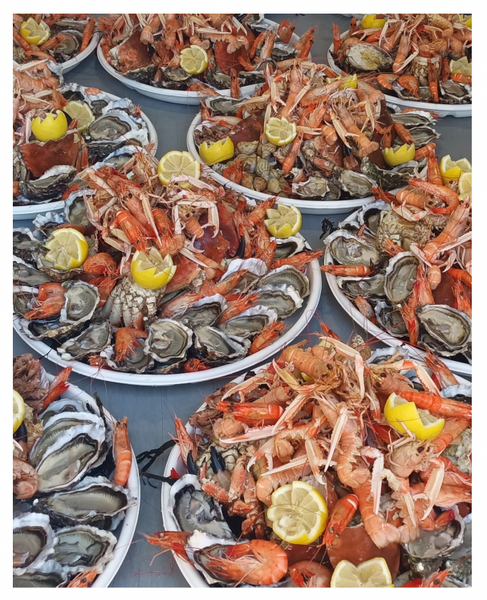
(Actual lunch photo.)
Jumping back into WWII today, we'll head west towards the English Channel to the region that the Nazis were sure the Allies would invade over the choice of Normandy.
Our first stop is fairly extraordinary. We'll climb inside a massive concrete rocket-launch facility that is right out of a Star Wars movie set. The V2 site called 'La Coupole' is impressive on its own. But it also contains a fantastic museum about Adolf & Werner von Braun's V1 and V2 rockets, the slave laborers that built them, and the French Resistance that fought back.
We'll head further west to the coast for lunch at Boulogne-sur-Mer and catch sight of the battle-scarred remains of the S-boat (Schnellboot) bunker that 700 Allied aircraft bombed in September 1944 before Canadian ground forces over-ran the port and city.
After lunch a short drive takes us up towards Calais to the Museum of the Atlantic Wall. A museum built into a massive gun emplacement that fired on shipping from early 1942 right up to D-Day. It was up to the 3rd Canadian Infantry Division in September 1944 to take the area against 1,800 German soldiers and sailors. For 'big gun' fans you can climb on top of a Krupp K5 E Railway Gun. One of only 21-25 ever built, with only 2 still in existence (the other one is on an Army base in Virginia).
We'll make a stop at the Mimoyecques Fortress that was going to be a giant V3 gun permanently aimed at London firing one projectile every 6 seconds. It used solid-fuel rocket boosters instead of explosive charges and had a secondary propellant charge to add velocity. The RAF bombed the facility in July 1944 with 5,400kg Tallboy earthquake bombs that entombed hundreds of slave workers underground. Abandoned by early September, it fell to the 3rd Canadian without resistance on September 5, 1944.
Our last stop of the day is Dunkirk. We'll visit the museum about the legendary 1940 evacuation. It is housed in the former Allied headquarters. We'll also have some time on the long concrete jetties where many evacuating soldiers, British and Canadian, were loaded onto ships during the German bombardment.
(One of only two Krupp K5 E Railway Guns left in the world.)

DAY 8 BRUGES & ADEGEM
ESSENTIALS
-
Bruges
-
Adegem Canadian Cemetery
-
Canadian-Polish War Museum
-
Bailey-Bridge

(Actual hotel photo.)
A visit to Northern Belgium wouldn't be complete without a stop in the ancient wealthy trading city of Bruges. Untouched by WWI and WWII. Liberated in September 1944 by the 12th Manitoba Dragoons.
We'll enter the city via Canada Bridge and get set up in a very nice hotel in town. You can either spend the day shopping and dining to your heart's content or optionally travel with us on a short journey out to the Adegem Canadian War Cemetery and the Canada-Poland War Museum about 1/2 hour to the east.
The Adegem cemetery holds 848 Canadian soldiers, most of whom died in October/November 1944 during Operation Switchback and Operation Vitality as they fought to clear the Scheldt Estuary in The Netherlands. We're headed to the Scheldt tomorrow.
The nearby museum features restored vehicles, dioramas and reconstructions, information on the Belgian resistance and uniforms and personal items from Canadian, British, Polish and German soldiers.
Before we head back to Bruges for dinner, we'll visit a still-existing, still-in-use Bailey bridge on the Dutch border. Royal Canadian Engineers built the largest (558m) Bailey bridge ever constructed during WWII over the Rhine. This one is a little smaller. There is a touching memorial poem at this site in Dutch to the Canadians who fought and died to take this canal. The last line reads,"Canadians on both sides (of the canal). Too long in the county to return. Too deep in the ground to march away."
(Actual hotel photo.)

DAY 9 BATTLE OF THE SCHELDT & DELFT
ESSENTIALS
-
Operation Walcheren
-
Operation Infatuate
-
Uncle Beach
-
Bergen op Zoom
-
Delft

(Actual hotel photo.)
If you can pry yourself away from Bruges, we've got an interesting day heading into a place we love for the seafood, but that few tourists ever reach: The Scheldt.
In order to be able to access the hugely important port of Antwerp to keep the Allied Armies supplied for the drive into Germany, the First Canadian Army needed to clear the Scheldt river estuary. The German defenders had been reinforced. It took five weeks of difficult fighting and 21,000 Allied casualties (3,400 Canadian) to clear the northern peninsula after numerous amphibious assaults and battles.
As we work our way through the area we'll visit Canadian amphibious landing memorials, Atlantic Wall bunkers, and heartfelt Dutch memorials to their Canadian liberators.
This part of Europe is where a lot of Paris, Brussels and Amsterdam's mussels, clams and oysters come from. For lunch, we're going to eat them right after they're brought out of the sea. Prepared for us, of course. But fresh as fresh seafood gets.
Operation Infatuate was the name given to the capture of the Walcheren peninsula. Because Montgomery detached several divisions from the First Canadian Army, Canada had to take on the entire Germany 15th Army with only three divisions. The Germans were in strongly fortified positions in a landscape that favoured the defensive.
The land was flooded and full of booby traps. Canadians fought in driving rain against an enemy who fought with more ferocity than they had in a long time.
General Montgomery was almost fired for his actions during this battle. Germany was determined. Canadians got the job done, taking 41,000 German prisoners.
Canada's policy of an all-volunteer army meant that these men had been fighting virtually non-stop since D-Day.
(Actual hotel photo.)

DAY 10 DELFT
ESSENTIALS
-
Royal Delft
-
Antiques
-
Art
-
Open Market

(Royal Delft painting class.)
The famous artist Johannes Vermeer was born in Delft, painted in Delft, and lived his life here. We've found Delft to be one of the most charming and interesting cities in The Netherlands.
Founded in 1653, the Royal Delft pottery factory is still making hand-painted Delft Blue. You can paint some yourself at one of their painting workshops. The Royal Delft museum and factory is fascinating to visit. And the gift shop is hard to resist.
We arrange our trips so that we're in Delft on Thursday when the open market is held in the main square between the city hall and the church. Some of the best cheese, bread, fish, roasted nuts, and Moroccan olive oil we've ever tasted. 150 stalls to choose from.
Delft isn't just charming, it also has some of the most original shopping available. Antiques, art, original pottery and porcelain... you can get a lot of your gift shopping done in a day. Not to mention the abundance of pubs, cafes and open air terraces to enjoy.
We're taking a break from the wars here today to enjoy a free and beautiful city that owes today's peace and tranquility to Canada's effort and sacrifice.
(Actual hotel photo.)

DAY 11 GROESBEEK, BRIDGE TOO FAR, WESTERBORK
ESSENTIALS
-
Groesbeek
-
Vrijheidsmuseum
-
Operation Market Garden
-
Apeldoorn
-
Holten Canadese Begraafplaats
-
Nijverdal Museum
-
Westerbork

(Actual hotel photo.)
We're going to cross the entire country today (in about 1.5 hours) and head east to where the final spring offensive began in 1945.
We'll visit the Canadian War Cemetery in Groesbeek on the German border as well as the liberation museum in the nearby town.
Canadian forces had been here before, of course, during September of 1944's Operation Market Garden. And not just as Royal Canadian Air Force flyers. 20 Canadian officers with the 1st British Airborne Division's 'Red Devils' parachuted in with the Brits. Only 2 were evacuated. Their stories are incredible.
We'll move north through the town of Nijmegen up to the Bridge Too Far at Arnhem, cross the bridge, and visit the museum on the river's bank.
After a quick stop in Apeldoorn to see the National Canadian Liberation Monument, our path takes us east to the Canadian cemetery in Holten, and to a fascinating monument to the Dutch Resistance.
We'll visit a Dutch museum dedicated to WWII and freedom before heading up north to Westerbork. If you know the name, you know that Westerbork was a concentration/transit camp liberated by Canadian forces in April, 1945.
Westerbork was surprisingly first built by the Dutch before the outbreak of WWII as a refugee camp for Jews fleeing Germany.
Germany's invasion of The Netherlands in May 1940 changed the camp's purpose and it evolved into a Dutch Jew's first stop on the way to Nazi extermination camps further east. 98,000 people passed through. 876 survived the war. Anne Frank and her sister Margo passed through Westerbork.
We'll spend the night in the University town of Groningen.
(Actual hotel photo. Center with garden.)
DAY 12 GRONINGEN, KAZEMATTEN, AMSTERDAM
ESSENTIALS
-
Groningen
-
Bevrijdingsbos
-
Missing Airmen
-
Stopping the Blitzkreig
-
Arrive in Amsterdam

(Actual hotel photo.)
In mid-April, 1944, the 2nd Canadian Division attacked 7,000 German Wehrmacht, SS, Luftwaffe, as well as Dutch and even Belgian SS soldiers guarding Groningen.
We'll visit the central market square and see where Canada used tanks - instead of artillery - in order to reduce harm to civilians while taking out Nazi machine gun nests.
In a coordinated infantry/armour regiment attack, 5,000 Axis defenders surrendered. 2,000 escaped into Germany, a mere 50km to the east.
We'll visit the town's Canadian memorial where they express gratitude to their liberators. We'll also tour the Synagogue.
2700 Jews lived in Groningen in 1940 before being deported to Westerbork. A mere 120 returned in 1945.
Returning Jews mostly found little empathy from the Dutch - who saw themselves as victims of the occupation and therefore not responsible either for the horrors of the Holocaust, nor for the return of Jewish property, homes and businesses.
After our morning in Groningen, we'll load up the luxury coach and head west to the sea. We'll pass the town of Leeuwarden that was liberated by the 3rd Canadian Infantry... travel west of the town of 'Sneek'... just below the West Frisian Islands, and then make a couple of unique stops.
First to a newer monument to air crews that is unlike anything we've seen before. Creative and moving, in our opinion. After that, we'll head out to sea (but on land).
Our next stop is all in Dutch, so we have to do some translating, but it's worth it. We'll visit a spot where the Dutch halted the Blitzkrieg in May of 1940. 225 Dutch soldiers fended off 15,000 Germans and were undefeated for many days until forced to surrender by the country's capitulation.
After that, we'll drive over the giant Afsluitdijk that was built in 1932. The largest hydraulic engineering project undertaken by The Netherlands during the twentieth century.
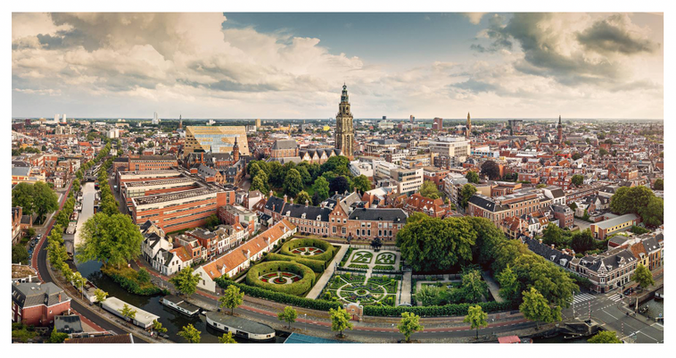
Once we've crossed the dijk, it's a straight one hour run south to your hotel in Amsterdam where you'll have one of the most unique views of the city that exists.
(Actual hotel photo.)

DAY 13 TOUR END
ESSENTIALS
-
Breakfast
-
Airport Transfer
-
City Recommendations
Though we won't be with you at breakfast this morning, we're not far away. The buffet at your hotel is wonderful. The a la carte choices are exceptional as well.
You can enjoy a riverside view of the city with your breakfast, and you're in a location with some very interesting things to do just steps from the hotel.
If you're heading out of town, a short walk and ferry ride will take you directly to Amsterdam Centraal Station where trains frequently leave to the airport. Alternatively, you can have a cab or ride-share service come right to the hotel.
If you're staying in the city and looking for recommendations on where to stay, dine, or what to see in Amsterdam, even though we're Americans, we've lived, worked, and traveled there many times over the last four decades. We would love to help you skip (or skim) the touristy parts and experience the best this fine city has to offer, in whatever way best suits your interests!
There are a number of war-related memorials across the city that you might be interested in. They can be a little bit subtle or unobtrusive, but no less fascinating. We'll help you find the ones that interest you the most.

Are You Tagging Along?
We Have Thought Of You Too

This tour is designed to be exciting and interesting to all kinds of people.
But maybe you're going along with a spouse, or helping a friend or family member work on their bucket list?
We work to ensure that great views, amazing food, beautiful beaches, quaint towns, unique shopping experiences and well-appointed châteaus and castles are all there to make everyone's trip a wonderful experience. With breaks for free time in some incredible places!
When we share stories about Canadians involved in the two world wars, we do our best to make the stories personal and compelling. This tour is not about specific dates, the finer points of military hardware and dull lectures. It's about Canadians and what they went through during some of the most challenging times of their lives.
Do come. It won't be the same without you.